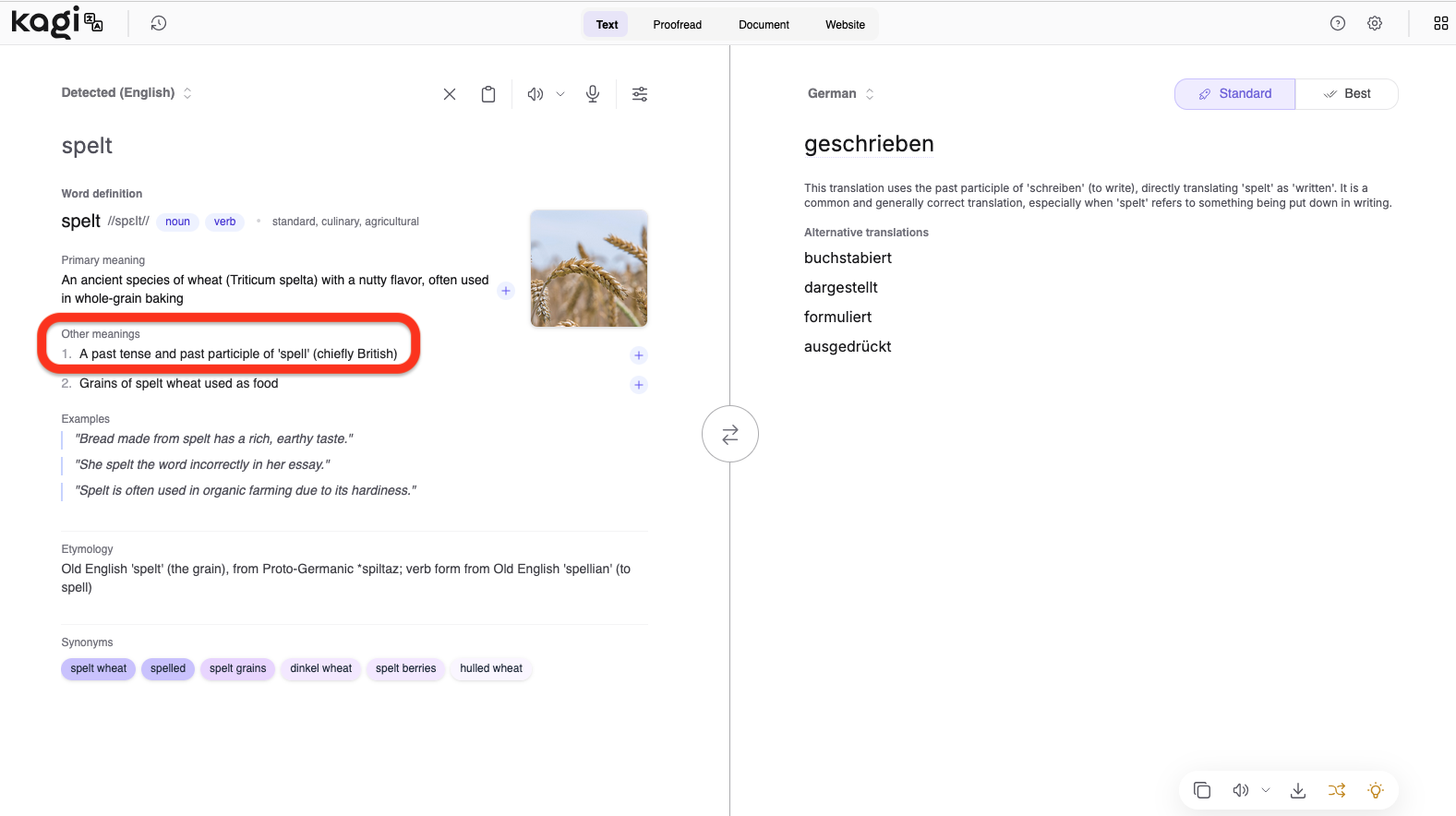
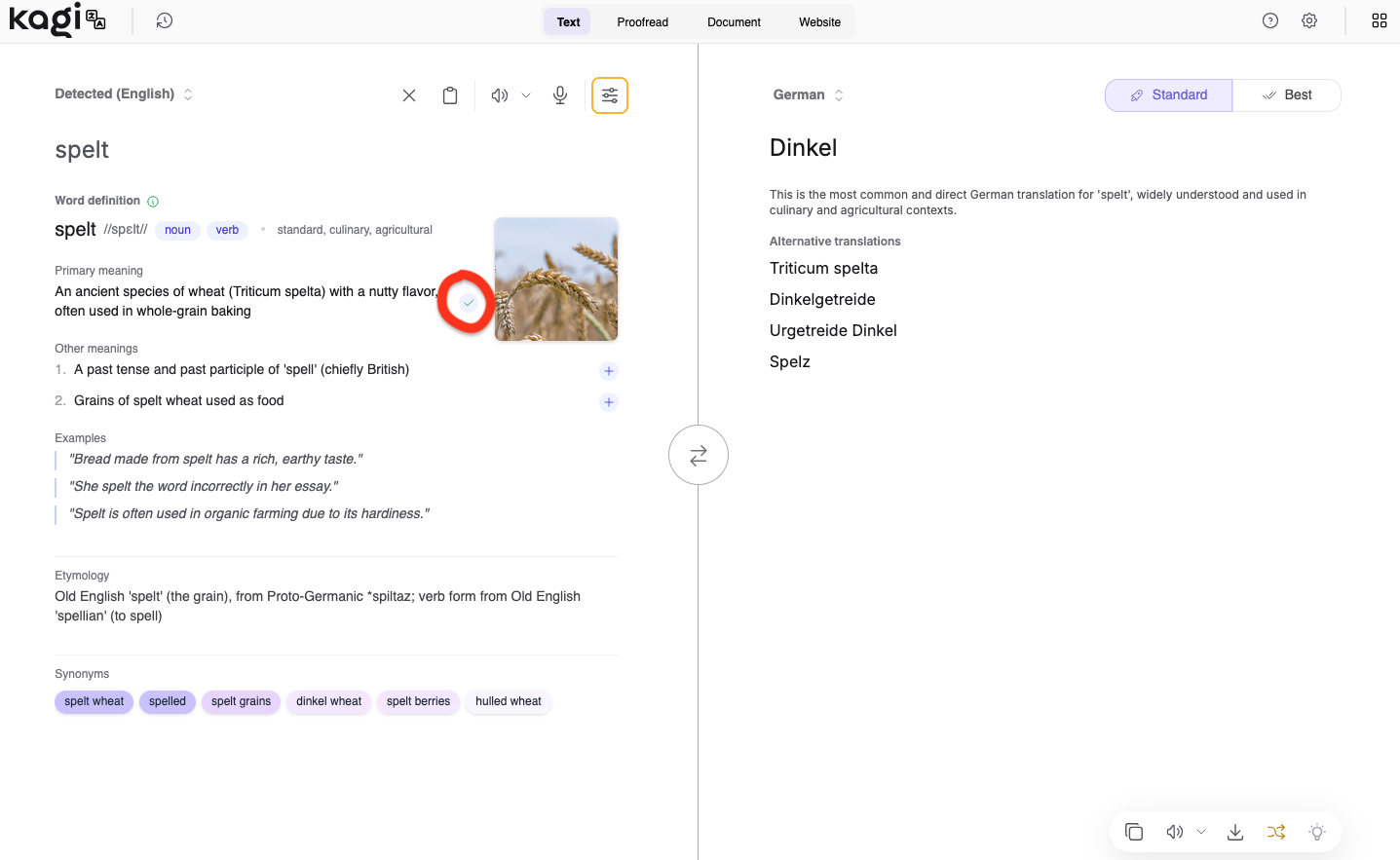
I've actually tried the "Best" mode and did notice that it lead to the correct translation, but it wasn't clear to me that "Best" implies using (or happens to use) the primary meaning, and "Standard" doesn't.
I assume most people just think "Standard" vs "Best" means that different ML models are used for quicker vs better translation, but still with the same input (and for that expecting the primary meaning as input).
And selecting a meaning on the left side also didn't switch the mode from "Standard" to "Best", so those didn't seem to be connected.
I can imagine now how it works behind the scenes: For "Standard" maybe you do the translation already asynchronously with just "spelt" as input, while at the same time, concurrently, you fill the left side with the different meanings. For speed as you said. And with "Best" you fill the left side first, and then pass it to the translation, to give it more context. And either you only pass the primary meaning then, or even everything and the model picks up the primary meaning on its own.
But from a user perspective you can understand how it's confusing that there's a primary meaning defined on the left, and it's not used for the translation on the right, and there's no clear indication that it has to do with the mode. Right?
Potential improvement ideas:
- What about doing the quick translation on the right side first, but as soon as the left side is filled, the primary meaning is automatically picked, and the right side then updated. While changing UI content after a second or so is usually an anti-pattern, this is already partially happening if I'm not mistaken. Even in "Standard" the translated word is shown first, and context added later.