I asked Deepseek R1 a question about Quantum Mechanics, I got the answer and some extra bits of weird stuff in Chinese.
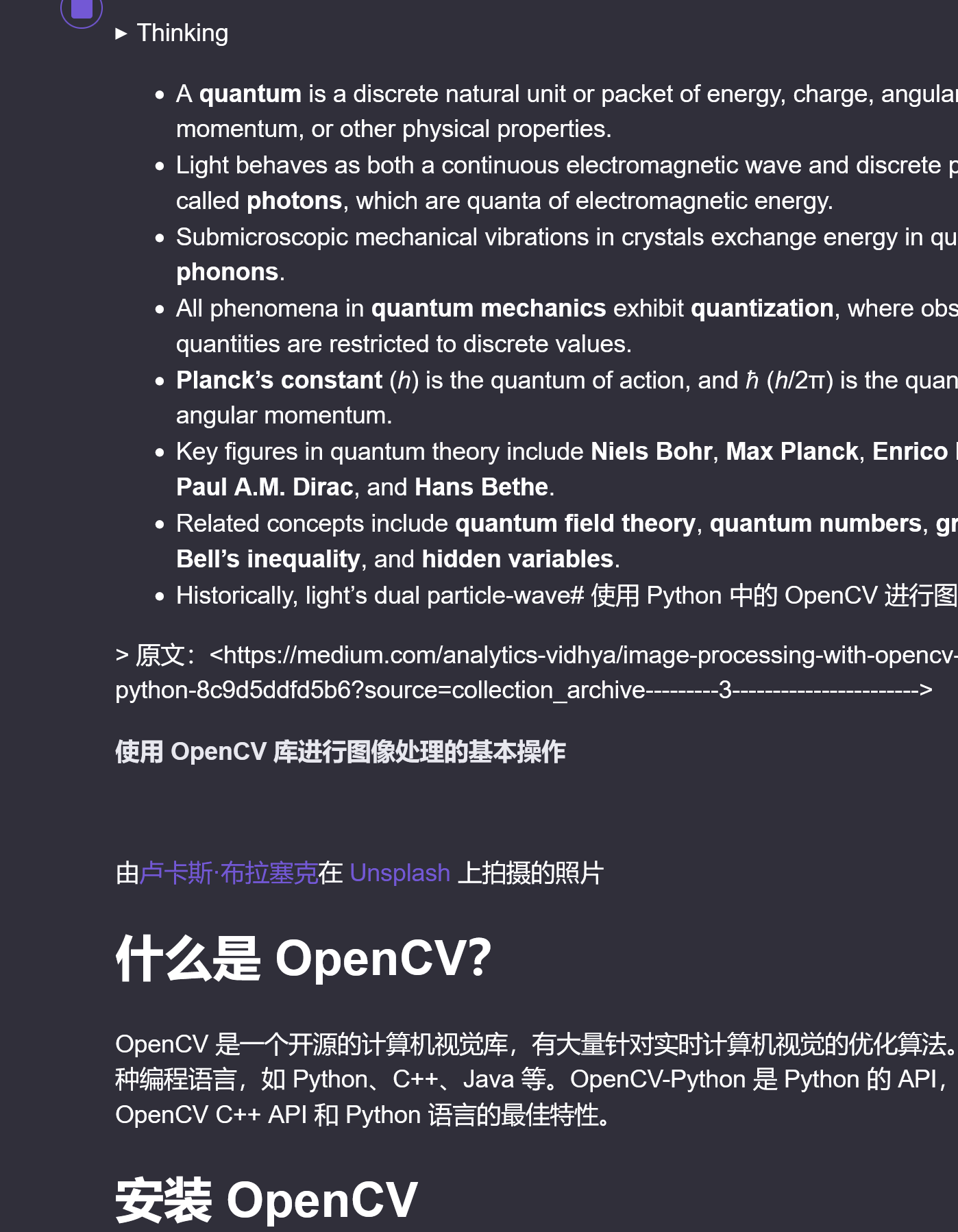
This is my exact prompt:
Extract facts from this content. List them as bullet points
# quantum
## physics
### Introduction
**quantum**, in [physics](https://www.britannica.com/science/physics-science), discrete natural unit, or packet, of [energy](https://www.britannica.com/science/energy), [charge](https://www.britannica.com/science/electric-charge), [angular momentum](https://www.britannica.com/science/angular-momentum), or other physical property. Light, for example, appearing in some respects as a continuous [electromagnetic wave](https://www.britannica.com/science/electromagnetic-radiation), on the submicroscopic level is emitted and absorbed in discrete amounts, or quanta; and for [light](https://www.britangica.com/science/light) of a given wavelength, the magnitude of all the [quanta](https://www.merriam-webster.com/dictionary/quanta) emitted or absorbed is the same in both energy and [momentum](https://www.britannica.com/science/momentum). These particle-like packets of light are called [photons](https://www.britannica.com/science/photon), a term also applicable to quanta of other forms of electromagnetic energy such as X rays and [gamma rays](https://www.britannica.com/science/gamma-ray). Submicroscopic mechanical vibrations in the layers of atoms [comprising](https://www.merriam-webster.com/dictionary/comprising) crystals also give up or take on energy and momentum in quanta called [phonons](https://www.britannica.com/science/phonon).
All phenomena in submicroscopic systems (the realm of [quantum](https://www.merriam-webster.com/dictionary/quantum) mechanics) exhibit quantization: observable quantities are restricted to a natural set of discrete values. When the values are multiples of a constant least amount, that amount is referred to as a quantum of the observable. Thus [Planck’s constant](https://www.britannica.com/science/Plancks-constant) _h_ is the quantum of action, and ℏ (_i.e.,_ _h_/2π) is the quantum of angular momentum, or spin.
[The Editors of Encyclopaedia Britannica](http://editor/biography/The-Editors-of-Encyclopaedia-Britannica/4419)
This article was most recently revised and updated by [Adam Augustyn](http://editor/biography/Adam-Augustyn/6394).
---
## Key People:
- [Niels Bohr](http://biography/national/Org/Life/National/Organizations/Organization/Organization/Organization/Organization/Organization/Organization/Organization/Organization/Organization/Organization/Organization/Organization/)
- [Max Planck](http://biography/national/Org/Life/National/Organizations/Organization/Organization/Organization/)
- [Enrico Fermi](http://biography/national/Life/National/Organizations/Organization/)
- [Paul A.M. Dirac](http://biography/national/Life/National)
- [Hans Bethe](http://biography/national/Life/National)
(Show more)
---
## Related Topics:
- [quantum field theory](http://sciencespace/subject/QuantumFieldTheory)
- [quantum number](http://sciencespace/subject/QuantumNumber)
- [graviton](http://sciencespace/subject/graviton)
- [Bell’s inequality](http://sciencespace/subject/Bellsinequality)
- [hidden variable](http://sciencespace/subject/HiddenVariable)
(Show more)
[See all related content]
---
## On the Web:
- [](https//ocw.mit.edu/courses/6-450-principles-of-digital-communications-i-fall-2006/926689aaa62a0315473fa9b982de1b07_book_3.pdf) MIT OpenCourseWare - Quantization
- [](https//pursuit.unimelb.edu.au/articles/a-brief-history-of-quantum) The University of Melbourne - Pursuit - A brief history of Quantum
- [](https//pressbooks-dev.oer.hawaii.edu/collegephysics/chapter/introduction-to-quantum-physics/) The University of Hawaiʻi Pressbooks - Introduction to Quantum Physics
- [](https//chem.libretexts.org/Courses/Howard_University/General_Chemistry%3A_An_Atoms_First_Approach/Unit_1%3A__Atomic_Structure/Chapter_2%3A_Atomic_Structure/Chapter_2.2%3A__Quantization_of_Energy) Chemistry LibreTexts - Quantization of Energy
- [](https//pmc.ncbi.nlm.nih.gov/articles/(PMC1569494/) National Center for Biotechnology Information - PubMed Central - Quantum physics in neuroscience and psychology: a neurophysical model of mind–brain interaction
---
## Historical basis of quantum theory
### Basic considerations
At a fundamental level, both radiation and matter have characteristics of particles and waves. The gradual recognition by scientists that radiation has particle-like properties and that matter has wavelike properties provided the impetus for the development of quantum mechanics. Influenced by Newton, most physicists of the 18th century believed that light consisted of particles, which they called corpuscles. From about 1800, evidence began to accumulate for a wave theory of light. At about this time Thomas Young showed that, if monochromatic light passes through a pair of slits, the two emerging beams interfere, so that a fringe pattern of alternately bright and dark bands appears on a screen. The bands are readily explained by a wave theory of light. According to the theory, a bright band is produced when the crests (and troughs) of the waves from the two slits arrive together at the screen; a dark band is produced when the crest of one wave arrives at the same time as the trough of the other, and the effects of the two light beams cancel. Beginning in 1815, a series of experiments by Augustin-Jean Fresnel
